


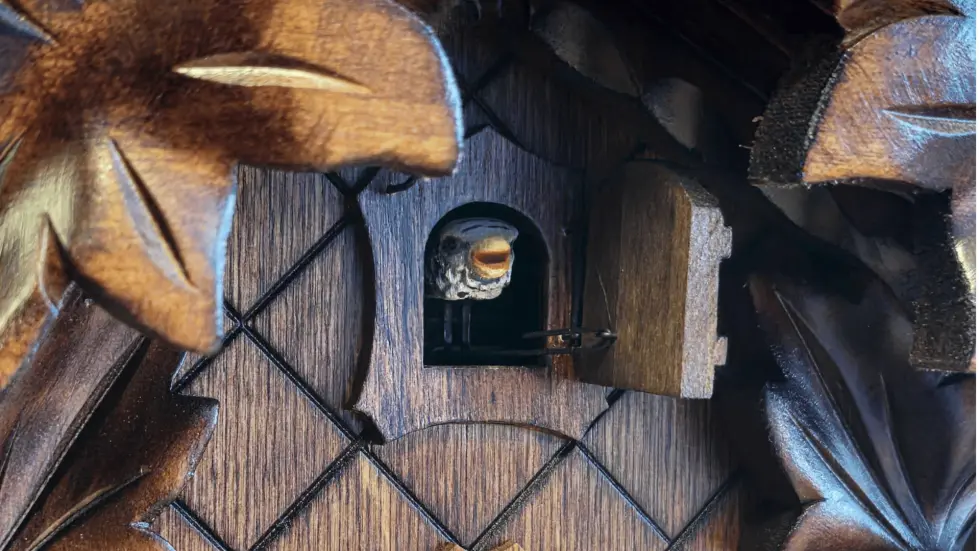
Cuckoo clock sound: how the clock imitates the bird
For nearly three centuries, the cuckoo call has been the signature of Black Forest clocks. Behind these two familiar notes lie a very real bird, a principle borrowed from the organ and, on mechanical models, two tiny wooden bellows.
A call borrowed from the bird
In nature, the “cuck-oo” is the song of the male cuckoo, heard in spring. The female makes a completely different call. It is this song that gave the bird its name: “cuckoo” is an onomatopoeia. Its two notes descend. In April, the gap between them is a minor third, then it widens as the season goes on.
With only two notes, this call lends itself well to imitation. As early as 1650, the scholar Athanasius Kircher described a mechanical cuckoo built into an organ, its call produced by two pipes and their bellows. In 1669, Domenico Martinelli suggested using it to strike the hours. The rest of the story is told in our article on the history of the cuckoo clock.
Two bellows and two wooden pipes
On a mechanical cuckoo clock, the call comes from two small wooden bellows, closed with a thin flexible membrane made of skin or special paper. Each one sits on a small wooden pipe, closed at one end like some organ pipes. The shorter pipe gives the high note, the longer one the low note.
On the hour, the mechanism lifts the bellows one after the other, then lets them drop, pulled down by small weights. The air pushed out whistles through the pipe: first the high note, then the low one, just like the bird. Slots cut into the sides of the case let the sound out.
The cuckoo calls the number of the hour, and once on the half hour, as on this model with a bird with spread wings. Our guide to how a cuckoo clock works explains what triggers the call right on the hour.
When the cuckoo loses its voice
The “cuck-oo” only sounds right if the two notes follow each other at the right rhythm. If one of the bellows stops working, you only hear a single note. Complete silence often has a simple cause:
transport clips still fitted on the bellows;
a lifting wire that has come loose;
a shut-off lever left in the silent position.
Our troubleshooting guide helps you understand why a cuckoo stops calling.
Over the years, the bellows membrane wears from constant folding, and leaks appear at the creases. A clockmaker can then replace it to give the cuckoo back its voice. Also avoid the mistakes that damage it, such as using the lever while the cuckoo is calling.
What about a quartz cuckoo clock?
No bellows here: the call is a digital recording, often of a real cuckoo in the wild, played through a small speaker. The bird is moved by an electromagnet and only comes out on the full hour.
On this clock with raised leaves, the call rings out with an echo effect before one of twelve melodies. A selector lets you choose between cuckoo and music, cuckoo only or silence, and the volume is adjustable.
At night, the two movements also differ. On a quartz clock, a light sensor often silences the call as soon as the room goes dark. On a mechanical clock, the call is usually switched off by hand with the shut-off lever, but some models do it automatically. Our guide to the quartz cuckoo clock explains how it works.
Wooden bellows or a recording: our guide helps you choose between a mechanical or quartz cuckoo clock.