A quartz cuckoo clock offers the call, the music and the animations of a Black Forest cuckoo clock, with no winding at all. Here is how it works and what it changes in everyday life.
A battery-powered movement
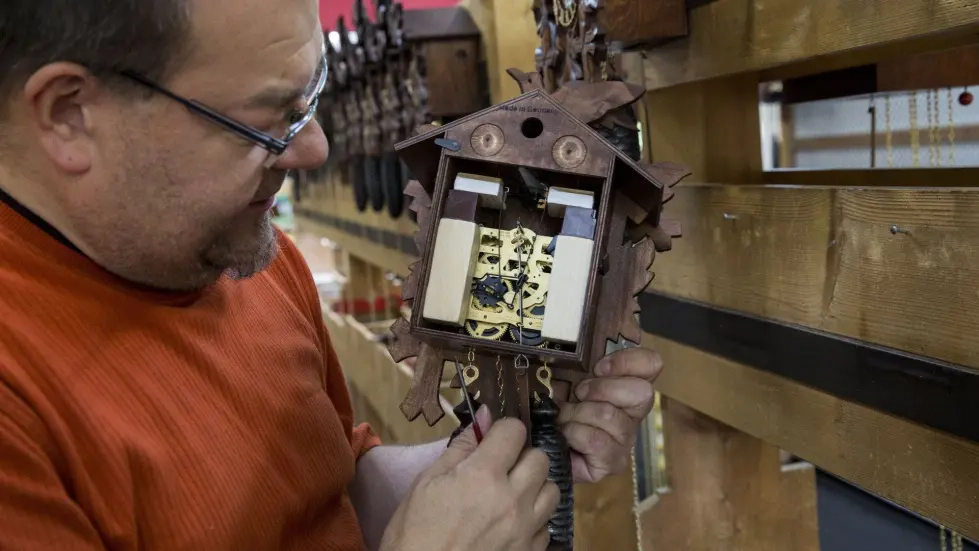
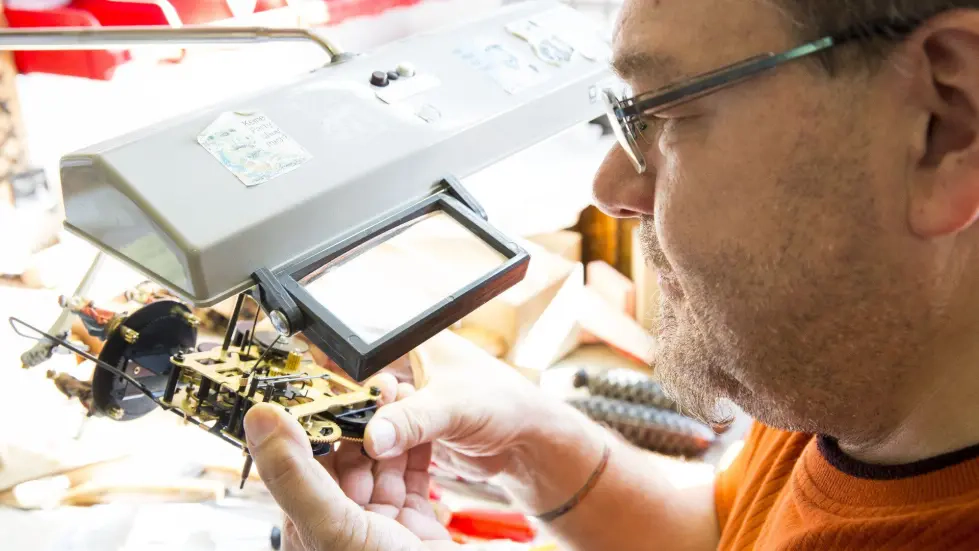
The heart of a quartz cuckoo clock is a small electronic movement powered by batteries. Inside, a quartz crystal vibrates at a very stable frequency, which ensures accurate time without any adjustment. Its pine cone weights and its pendulum are decorative: they play no part in how the clock works.
The call and the music
On every full hour, the little door opens and the bird appears. An electromagnet makes it move while its call sounds, often a recording of a real cuckoo. On a mechanical cuckoo clock, by contrast, the sound comes from two bellows.
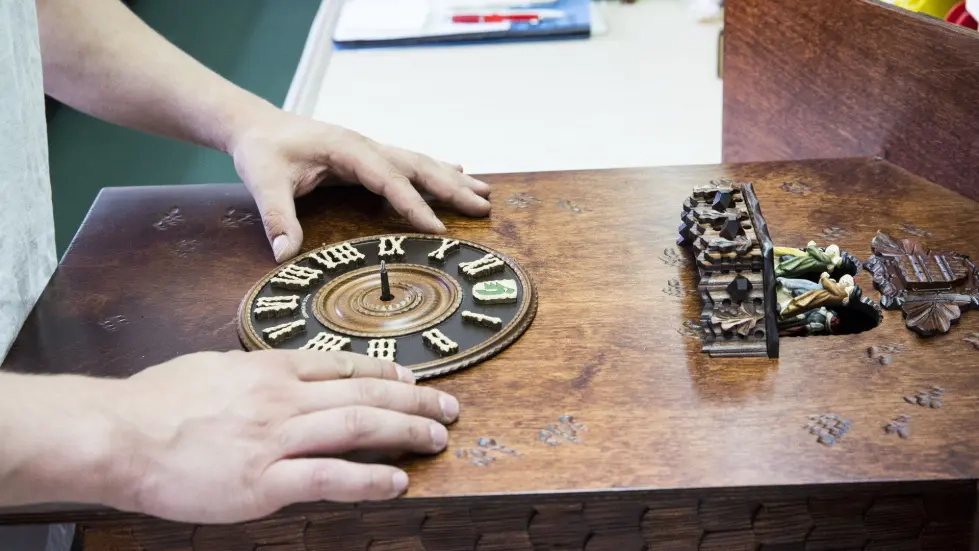
On musical models, a melody follows the call. It is chosen from twelve tunes that change from one hour to the next, and the figures move at the same time, as on this beer drinker chalet.
The night sensor and settings
A light sensor automatically silences the call and the music as soon as the room goes dark, then restores them in the morning. The clock itself keeps running. Some models also have a switch to choose between the call alone, the call with music or silence, and sometimes a volume control.
Maintenance limited to batteries
No winding, no oiling: simply change the batteries as soon as the clock stops. Use alkaline batteries of the type stated in the instructions, as some models need several. The clock just needs to hang straight, with no beat to adjust.
Who is a quartz cuckoo clock for?
It suits anyone who wants to enjoy the call without constraints: as a gift, in a bedroom thanks to the night sensor, or in a holiday home where the clock is left alone for several days.
One point to know before buying: the VdS certificate is reserved for mechanical cuckoo clocks. A quartz clock therefore cannot obtain it, even if it is made in the Black Forest. To weigh up the pros and cons, compare mechanical or quartz.