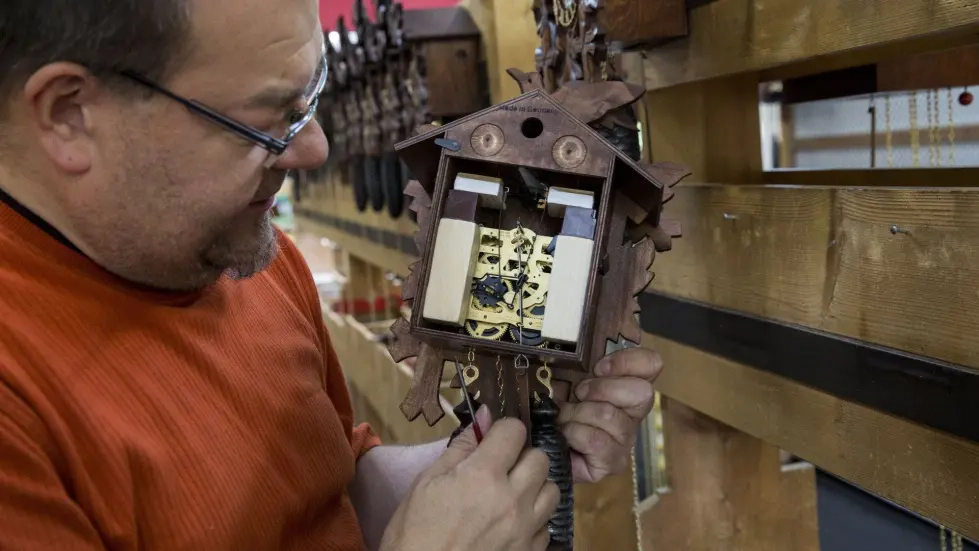
Beneath the dial of every mechanical cuckoo clock beats a clock movement. There are two main families, the 1-day movement and the 8-day movement, each available with or without music. This choice determines how often you wind the clock, how many weights it has and how much you will spend.
The 1-day movement
This is the traditional cuckoo clock movement. It must be wound every day, ideally at the same time, by gently pulling on the chains: our care tips explain the right technique.
Simpler in design, it is also the most affordable mechanical movement. You will find it on carved cuckoo clocks as well as on animated models, such as this woodchopper chalet.
The 8-day movement
The 8-day movement only needs winding once a week. To run that long, it is driven by heavier weights. More elaborate, it also costs more than a 1-day movement.
It is the right choice if you love mechanical clocks but would rather not wind yours every day, like this carved stag cuckoo clock.
With or without music: two or three weights
A mechanical cuckoo clock without music has two weights: one drives the hands, the other powers the call. In every case, the call comes from two small bellows, explained in our guide to the mechanical movement.
Musical models add a third weight, which plays a music box after the call and often drives animated figures: dancers, a water wheel or a woodchopper. Music and animations make the movement more complex, which is reflected in the price. Find out how musical cuckoo clocks work.
1-day or 8-day: which one to choose?
Choose a 1-day movement if daily winding is part of the pleasure and you are looking for a more affordable mechanical cuckoo clock.
Choose an 8-day movement if you would rather wind your cuckoo clock once a week, without giving up the mechanical call.
And if you would rather not wind it at all, a quartz clock runs on batteries: compare both options in our guide mechanical or quartz.